
Blog · TV Aerials · 2 August 2026
Why Is My TV Saying No Signal?
If your Freeview TV suddenly says “no signal” or “weak signal”, here's how to work out whether it's a cable, the aerial, an amplifier, or something outside your control.
Short answer: Common causes of a Freeview “no signal” message include a loose or damaged cable, aerial movement, an amplifier power failure, or a temporary transmitter or weather issue — a fault with the television itself is less common.
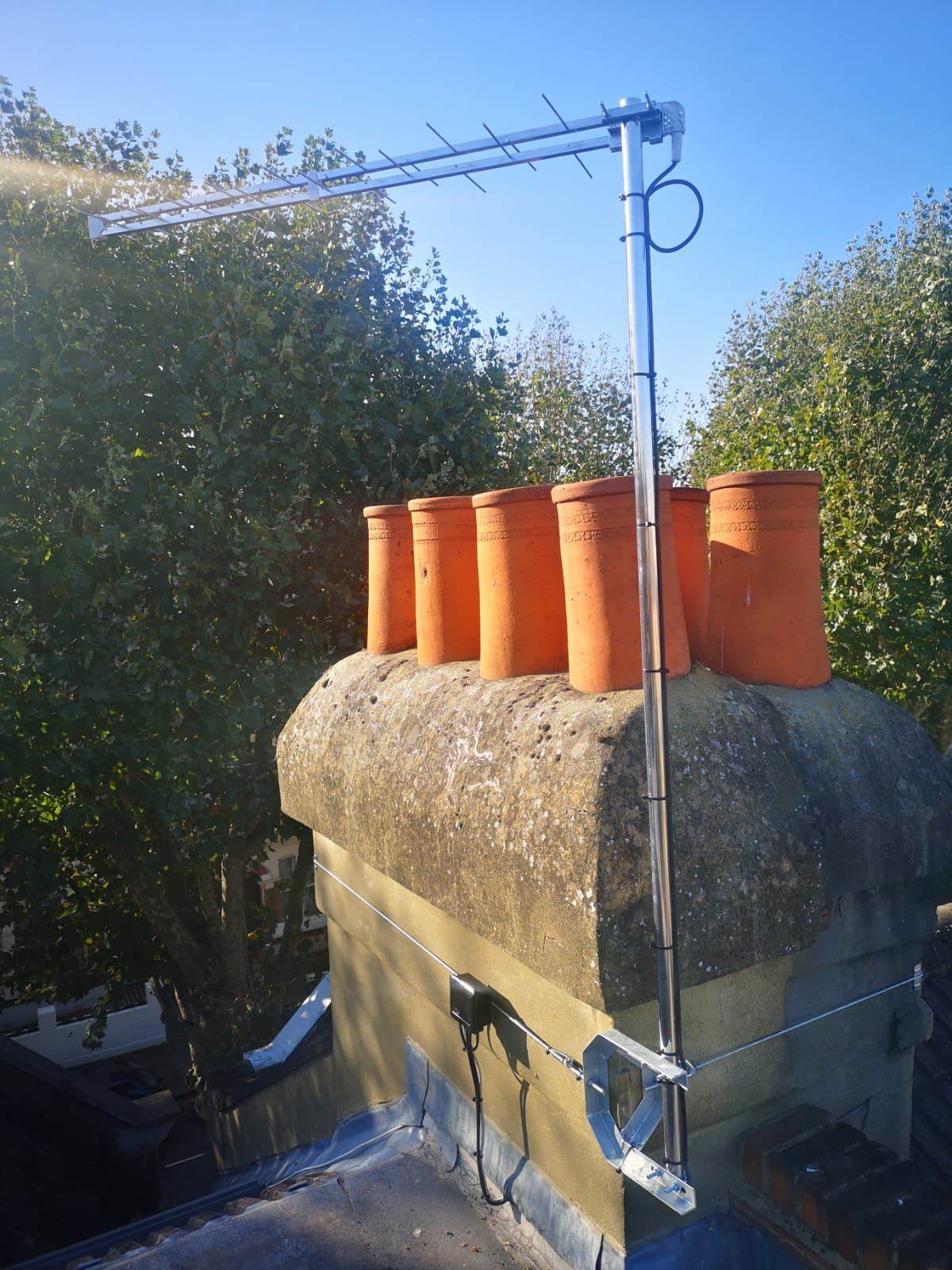
This article covers terrestrial (Freeview aerial) television. If the problem is with a Sky or Freesat satellite box instead, see our separate guide: Why Does My Sky or Freesat Box Say No Satellite Signal?
Is it one TV, or every TV in the house?
This is the first thing worth establishing, because it points you toward two very different causes.
Only one TV affected
Check that TV's own aerial connection and input/source setting first. A single affected set usually means a loose plug at that TV, a fault with a splitter feeding just that room, or a wiring point that's come loose behind a wall plate.
Every TV affected at once
If the whole house has lost signal together, the fault is more likely with the aerial itself, the main cable run from the aerial, a shared amplifier, or something outside the property such as the transmitter.
Loose or disconnected aerial cables
Coaxial connectors at the wall plate, the back of the TV, or any splitter box can work loose over time — especially after a TV has been moved, unplugged for cleaning, or knocked while vacuuming.
Damaged coaxial cable
Cable degrades wherever it's pinched, kinked, chewed by pets, or exposed to the weather outside. Water getting into an outdoor cable joint or connector is one of the most common physical faults behind a sudden loss of signal.
Aerial movement or damage
Aerials are aimed at a specific transmitter fairly precisely. High winds, a loosened mounting bracket, or physical damage can shift the aerial or bend its elements just enough to lose reception, even if nothing looks obviously wrong from a distance.
Amplifier or power-supply failure
Many aerial systems include a signal amplifier (booster), often with its own small plug-in power supply indoors. If that power supply has failed, been unplugged, or lost power at a tripped socket, signal can drop out completely across the whole house, even though nothing has physically changed at the aerial.
Temporary transmitter problems
Broadcasters occasionally carry out planned engineering work, and unplanned transmitter faults do happen from time to time. These affect a whole local area regardless of your own equipment. It's worth checking your TV platform's coverage or status checker before assuming the fault is at your property.
Weather-related interference
Weather affects Freeview reception in a few different ways, and it helps to know which is which:
- High pressure / unusual atmospheric conditions — settled high-pressure weather can occasionally cause temporary interference or signal disruption on terrestrial TV, even without rain or wind. This normally clears on its own once conditions change.
- Wind — the main physical risk from wind is that it moves or damages the aerial itself, or loosens its mounting, which is a mechanical fault rather than a weather-interference issue.
- Rain — rain doesn't usually interfere with the signal directly, but it can reveal an existing problem: water getting into a cable, connector or joint that was already damaged, causing a fault that appears (or gets worse) specifically when it rains.
If a fault only ever appears during or shortly after rain, that's a useful clue pointing toward water ingress in the cabling rather than the weather itself being the direct cause.
Incorrect retuning
Retuning rebuilds your channel list from what the TV can currently detect. Done at the wrong time, or during a period when broadcasters are making changes, it can leave gaps that look like a "no signal" fault on particular channels. It's also worth avoiding a retune while a temporary weather-related or transmitter issue is affecting reception, since the TV will only find what it can detect at that moment and may drop channels that come back once conditions clear.
When retuning can make things worse
If the underlying problem is actually a weak or damaged aerial system, retuning won't fix that — and can sometimes remove channels the TV had previously found, because a scan only keeps what it detects at that moment. If a full retune leaves you with fewer channels than before, that points toward an aerial or cabling problem rather than a simple tuning issue.
Safe checks you can do yourself
- Check the aerial cable is firmly pushed into both the wall plate and the TV
- If you have more than one aerial socket, try a different one to see if the fault follows the TV or stays with the socket
- Ask nearby neighbours or family whether they've lost signal too
- Check your TV platform's coverage or status checker for known local transmitter issues
- Restart the TV fully from the mains, not just standby
🚧 Please don't climb onto the roof or lean a ladder up against the house to inspect or adjust the aerial yourself. Checking or adjusting a roof aerial safely needs the right access equipment and training.
When an aerial engineer is required
If the checks above don't resolve it, if the aerial or its mount looks visibly damaged or leaning from ground level, or if the fault is intermittent and seems to get worse in wind or rain, a proper aerial and signal test is the only reliable way to identify the actual cause. Our TV aerial installation & repair service covers exactly this kind of diagnosis, and our emergency & same-day repair service is available if you've lost signal suddenly or the aerial has come down.
Official source: Freeview — reception, picture and channels troubleshooting guide.
AV Infusion is based in Welwyn and provides TV aerial, satellite, CCTV and TV wall-mounting services throughout Welwyn Garden City and the wider Hertfordshire area.
Frequently Asked Questions
Why has only one of my TVs lost signal, not the others?
This usually points to a fault local to that TV or its feed, such as a loose plug, a faulty splitter output, or a wiring point serving just that room, rather than a problem with the aerial itself.
Can bad weather really cause a TV to lose signal?
Yes. Heavy rain, snow or unusual pressure conditions can cause temporary picture breakup or a no-signal message, particularly if the signal strength at the property was already borderline. This usually clears once the weather passes.
Will retuning my TV fix a no signal message?
Sometimes, but not always. If the fault is actually a weak or damaged aerial or cable, retuning won't fix the underlying cause, and can occasionally remove channels the TV had previously found.
How do I know if it's my aerial or a transmitter problem?
If other households nearby have also lost signal, it's more likely a transmitter or area-wide issue. If it's just your property, the aerial, cabling or an amplifier is the more likely cause.
Is it safe to check my own aerial?
You can safely check cable connections indoors and look at the aerial from ground level, but roof or high-level access should always be left to a professional with the right equipment.